OpenAI Just Hired the 'Lobster' Creator — Here's Why It Matters
Table of Contents
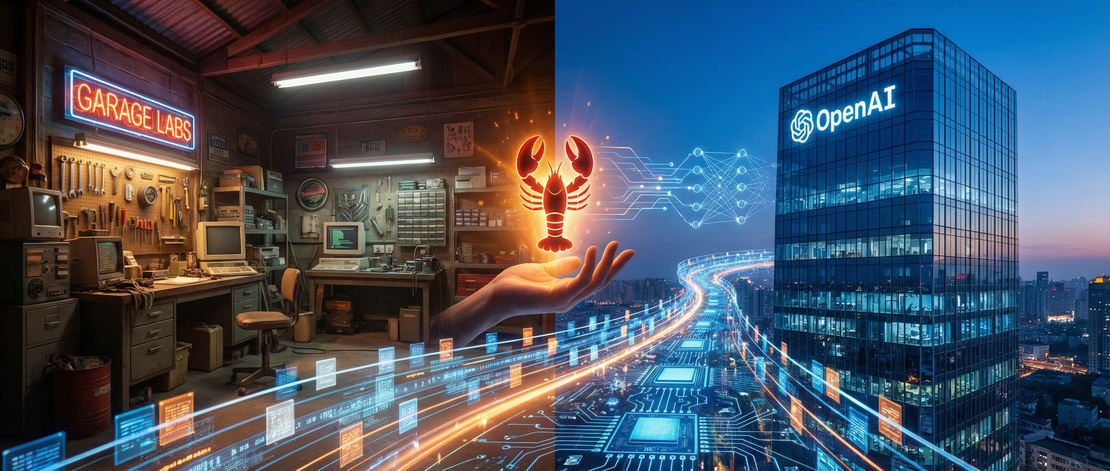
Sam Altman dropped a bomb on Sunday. In a post on X, he announced that Peter Steinberger — the Austrian developer behind OpenClaw, the open-source AI agent that’s been tearing through the tech world since late January — is joining OpenAI.
“Peter Steinberger is joining OpenAI to drive the next generation of personal agents,” Altman wrote. “The future is going to be extremely multi-agent and it’s important to us to support open source as part of that.”
If you haven’t been paying attention to the OpenClaw phenomenon, here’s the short version: a solo developer’s side project turned into the most-starred AI agent on GitHub (north of 150,000 stars), spawned an entire AI-only social network called Moltbook that hit 1.5 million agents in its first week, got into a trademark spat with Anthropic, drew acquisition interest from both Meta and OpenAI, and now its creator is heading to San Francisco to build “agents for everyone.”
This isn’t just a hiring announcement. It’s a signal flare about where the entire AI industry is heading.
What OpenClaw Actually Is (And Why People Lost Their Minds Over It)
Most AI products right now are fancy chatbots. You type, they respond. OpenClaw is different — it’s an AI that does things.
Steinberger describes it simply: “an AI that actually does things.” The agent runs locally on your machine, connects to your messaging apps (Telegram, Signal, Discord, WhatsApp), and acts on your behalf. It reads your emails, manages your calendar, browses the web, writes and runs code, coordinates with other agents. It remembers context across sessions. It has persistent memory, personality, and the ability to chain complex multi-step tasks together.
Built in TypeScript and Swift, licensed under MIT, and designed to work with any major LLM — Claude, GPT, DeepSeek — OpenClaw hit a nerve that no corporate AI product had managed to touch. The software is free. You only pay for the underlying model’s API costs. That combination of radical openness and genuine usefulness turned it into a movement.
The Moltbook phenomenon amplified everything. When entrepreneur Matt Schlicht launched a social network designed exclusively for AI agents, OpenClaw bots flooded in. The spectacle of 1.5 million AI agents socializing, posting, and interacting — while humans could only watch — became an irresistible viral moment. Wired sent a reporter to infiltrate it. CNBC covered it. TikTok went nuts.
By early February 2026, OpenClaw had crossed 145,000 GitHub stars and 20,000 forks. Companies in Silicon Valley and China were adapting it for enterprise use. Chinese developers wired it into DeepSeek and domestic super-apps. It was, by any measure, the fastest-growing open-source AI project in history.
Why OpenAI Needs This Guy
Here’s the strategic picture. OpenAI built ChatGPT into the most recognizable AI brand on the planet. But ChatGPT is fundamentally a conversation tool. You ask, it answers. That paradigm is already showing its age.
The next frontier — the one every major lab is racing toward — is agentic AI. Not chatbots that talk, but agents that act. Systems that can break a goal into sub-tasks, call APIs, search the web, write code, coordinate with other agents, and get things done without constant hand-holding.
OpenAI has been building toward this. Operator, their computer-use agent, launched in January. But Steinberger already solved a huge chunk of the agentic puzzle in the open, with a community of thousands of developers building skills and integrations around it. He built what OpenAI wants to become.
Steinberger’s own words from his blog post explain it clearly: “My next mission is to build an agent that even my mum can use. That’ll need a much broader change, a lot more thought on how to do it safely, and access to the very latest models and research.”
That last part is key. The best open-source agent in the world is still limited by whatever models are publicly available. Inside OpenAI, Steinberger gets access to unreleased research, frontier models, and the infrastructure to ship to hundreds of millions of users. For someone who wants to change the world rather than build a company — and he’s explicit about this, having already spent 13 years building PSPDFKit — it’s the right trade.
The Meta vs OpenAI Bidding War
Steinberger didn’t just field one offer. According to reporting from TrendingTopics and 36kr, both Meta and OpenAI had concrete offers on the table. Steinberger spoke with Satya Nadella at Microsoft too. Mark Zuckerberg was reportedly eyeing a full acquisition.
Why would the world’s biggest tech companies fight over a single developer and his lobster-themed AI project?
Because the personal AI agent is shaping up to be the next great platform war. Whoever controls the agent layer — the software that sits between you and everything you do on a computer — controls the most valuable chokepoint in tech. It’s the new browser. The new operating system. The new app store.
Meta wants it for WhatsApp and Instagram. OpenAI wants it for ChatGPT. Apple is working on it for Siri. Google is building toward it with Gemini. The difference is that Steinberger already built a working version that people love, and he did it in his spare time.
Steinberger chose OpenAI because, as he put it, “teaming up with OpenAI is the fastest way to bring this to everyone.” He spent a week in San Francisco meeting with major labs, and OpenAI’s vision aligned closest with his own.
The Security Elephant in the Room
OpenClaw’s rapid rise hasn’t been without problems. The agent requires broad system-level permissions to function — access to email, calendars, messaging, file systems. Cisco’s AI security team found a third-party OpenClaw skill performing data exfiltration and prompt injection without user awareness. Forbes and Axios have both covered the security risks extensively.
One of OpenClaw’s own maintainers warned on Discord: “If you can’t understand how to run a command line, this is far too dangerous of a project for you to use safely.”
A remote code execution vulnerability was discovered and patched in v2026.1.29, but the fundamental tension remains: an AI agent that can do everything for you can also be exploited to do everything to you. Prompt injection attacks — where malicious instructions are embedded in data the agent processes — remain an unsolved problem across the entire industry.
This is precisely why Steinberger’s move to OpenAI matters beyond just product strategy. Building agents that are both powerful and safe requires the kind of alignment and safety research that OpenAI has invested billions in. A brilliant hobbyist can build the prototype; shipping it to a billion users without catastrophic failures requires institutional muscle.
What Happens to OpenClaw?
Altman committed publicly: OpenClaw will continue as an open-source project under a foundation structure, with OpenAI sponsoring its development. Steinberger echoed this, saying the foundation will “stay a place for thinkers, hackers and people that want a way to own their data.”
Whether that plays out cleanly is an open question. History is littered with open-source projects that slowly withered after their creators moved on to corporate roles. But the community around OpenClaw is unusually energetic, and the foundation model — similar to how Linux, Kubernetes, and other major projects operate — gives it a fighting chance at genuine independence.
What This Means for You
The boring read is that a developer got a big job at a big company. The real read is that the age of the AI chatbot is ending, and the age of the AI agent is beginning.
Within the next year or two, the AI on your phone won’t just answer questions. It’ll book your flights, negotiate your bills, manage your inbox, coordinate your team’s schedules, and interact with other people’s AI agents to get things done. Peter Steinberger built the first version of that future in his living room. Now he’s going to build it for everyone.
The claw is the law. And apparently, so is OpenAI’s checkbook.